Table of Contents
1. What is a BRL auction? 2. Why central banks use BRL auctions 3. How BRL auctions work (process) 4. Types of BRL auctions 5. Who participates in BRL auctions 6. Market impact and liquidity effects 7. Risks and challenges of BRL auctions 8. Trader strategies around BRL auctions 9. Case studies: notable BRL auction interventions 10. Monitoring, tools, and future outlook for BRL auctionsWhat is a BRL auction?
Need a stable way to enter crypto markets? You can buy USDT with credit card instantly using a secure platform with transparent fees, fast processing, and a smooth experience.
A brl auction is a mechanism where the Brazilian central bank or authorized institutions sell or buy Brazilian reais (BRL) in an organized, transparent format to influence liquidity, stabilize the exchange rate, or relieve market stress. Unlike opaque central bank operations of the past, BRL auctions often come with published rules, schedules, and quotas that allow market participants to anticipate and participate. These auctions can take several forms — outright spot sales, swaps, or repo-style operations — but their common aim is to provide a controlled dose of currency supply or demand to the foreign exchange (FX) market.
Why central banks use BRL auctions
Central banks, including Brazil’s Banco Central do Brasil, deploy brl auctions to manage short-term volatility, defend policy targets, and ensure orderly markets. Auctions can be used to:
- Smooth excessive BRL volatility during sudden capital flows or geopolitical events.
- Provide liquidity when market depth is thin, preventing disorderly price moves.
- Signal policy intent without committing to permanent balance sheet changes.
By choosing auctions over ad-hoc interventions, authorities add predictability and reduce the chance of market misinterpretation. Auctions act as a policy tool that complements interest rate decisions, FX reserves management, and macroprudential measures.
How BRL auctions work (process)
The operational process of a brl auction typically follows a transparent sequence: announcement, bidding window, allocation, and settlement. First, the central bank announces the auction terms — amount, type (sell or buy), eligibility, and timing. Participants then submit bids or offers within the defined window. Allocation rules (pro rata, price-priority, or a mix) determine how much each bidder receives. Finally, settlement occurs according to standard market conventions, often T+0 to T+2 depending on the instrument.

Key procedural points traders watch for include price caps/floors, minimum bid sizes, and whether the auction is discretionary or rule-based. Rule-based auctions reduce informational asymmetry, while discretionary moves may carry stronger signaling power about future policy. Understanding the specific mechanics helps market participants model the likely immediate liquidity impact and subsequent price action in USD/BRL and other BRL crosses.
Types of BRL auctions
There are several common variations of the brl auction, each suited to different policy goals:
- Outright FX sales or purchases (spot) — direct intervention to add or remove BRL liquidity.
- FX swaps — temporarily exchange currency now with a reversal later, preserving reserve position.
- Repo-style operations — provide BRL liquidity against collateral for short periods.
Below is a quick comparison table showing how these auction types differ in purpose and balance sheet impact.
| Auction Type | Primary Purpose | Balance Sheet Impact |
|---|---|---|
| Outright FX Sale/Purchase | Directly influence spot rate | Reserves decrease on sales; increase on purchases |
| FX Swap | Temporary liquidity management | Short-term change; reverses at maturity |
| Repo | Domestic BRL liquidity & term control | Short-term liabilities; collateralized |
Who participates in BRL auctions?
Participants in brl auctions typically include local and international banks, primary dealers, institutional investors, and occasionally broker-dealers authorized by the central bank. Participation rules vary by auction: some are limited to a standing list of counterparties, while others allow broader access. Institutional players use auctions to hedge positions, source liquidity, or execute large FX flows with less market impact. Smaller banks may participate to manage intraday liquidity or meet client settlement needs.
For traders, recognizing who participates — and their likely motivations — helps forecast auction flow distribution and price sensitivity. When auctions include non-bank financial firms, the footprint can be broader, potentially amplifying market reactions.
Market impact and liquidity effects
Well-designed brl auctions can reduce volatility by absorbing concentrated flows, but the impact depends on size, frequency, and transparency. A sizeable auction can temporarily compress spreads, improve order book depth, and anchor market expectations about the central bank’s tolerance for currency moves. Conversely, unpredictable or insufficient auction sizes may fail to calm markets and could even encourage speculative probing.
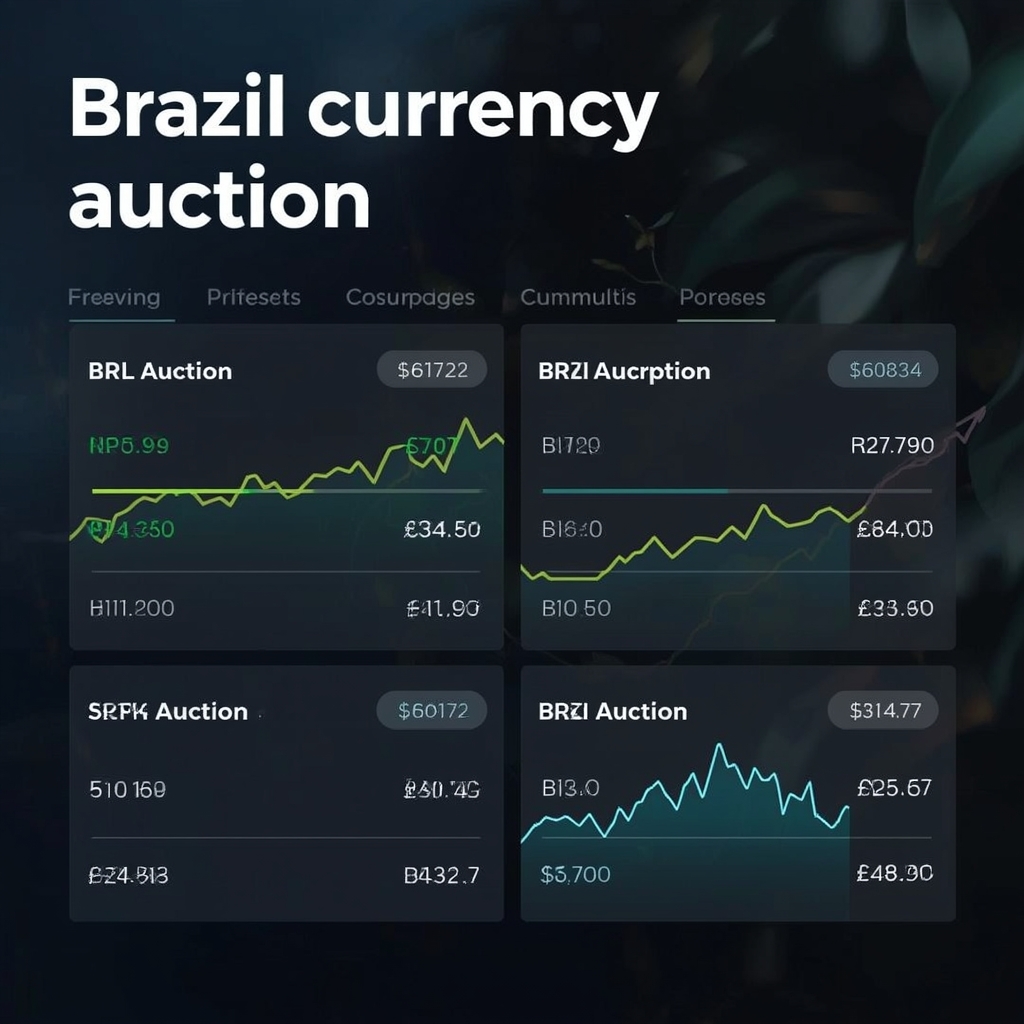
Short-term FX volatility metrics such as realized volatility, bid-ask spreads, and order-book depth are useful to monitor around auction windows. Traders often model the likely immediate effect of an auction by comparing auction size to average daily turnover in USD/BRL and using historical response elasticities to estimate impact on exchange rate levels.
Risks and challenges of BRL auctions
Despite their benefits, brl auctions come with risks. Policy credibility is crucial: repeated, large interventions without macro alignment (e.g., conflicting monetary policy) risk eroding confidence. Auctions also expose the central bank to potential losses if exchange rate moves persist against the intervention direction, especially for outright operations. For market participants, participation risk includes allocation mismatch, settlement risk, and signaling risk if bids reveal strategic positions.
Operationally, execution risk arises when auction documentation is unclear, or when counterparties misunderstand settlement or collateral terms. Finally, auctions can only manage symptoms; structural imbalances — fiscal deficits or capital flow shocks — require broader policy responses.
Trader strategies around BRL auctions
Traders can adopt several strategies to navigate brl auctions effectively:
- Pre-auction positioning: size exposure based on expected auction footprint relative to market depth.
- Auction arbitrage: exploit pricing differences between auction-implied rates and spot market quotes.
- Event-driven hedging: use options or forwards to protect downside risk from sudden moves post-auction.
Risk management is central. Tight stop-losses, disciplined position sizing, and scenario planning for allocation outcomes reduce the chance of being caught on the wrong side. Monitoring central bank communications for subtle shifts in language can offer advance clues on auction size or frequency changes.
Case studies: notable BRL auction interventions
Historical examples show how brl auctions have influenced markets. For instance, during episodes of sharp BRL depreciation, Brazil’s central bank has used FX-sales auctions combined with interest-rate adjustments to arrest declines and reassure investors. In other periods, coordinated swap lines and repo operations have stabilized domestic liquidity without large reserve depletion. Each episode underscores the need to analyze auction context — was it a one-off shock or part of a sustained policy campaign?
| Episode | Action | Market Outcome |
|---|---|---|
| Major FX Sell-off (example) | Large outright FX sales + rate statement | Short-term BRL stabilization; volatility later normalized |
| Liquidity Crunch (example) | FX swaps and repo auctions | Improved interbank liquidity; orderly FX pricing |
Monitoring, tools, and future outlook for BRL auctions
To stay ahead, market participants should monitor central bank calendars, auction announcements, and weekly reserve reports. Useful tools include real-time FX ticks, order-book analytics, and implied volatility surfaces from options markets. Market intelligence platforms and broker research often publish pre-auction expectations and post-auction summaries that help refine probability-weighted scenarios for BRL moves.
Looking forward, brl auctions are likely to remain a flexible policy instrument. With increasing integration of global capital markets, auctions may evolve in transparency, frequency, and complexity. Crypto and tokenized FX markets could someday augment traditional liquidity channels, but for now, brl auctions remain a core tool for central banks to manage FX shocks, support financial stability, and communicate policy intent.